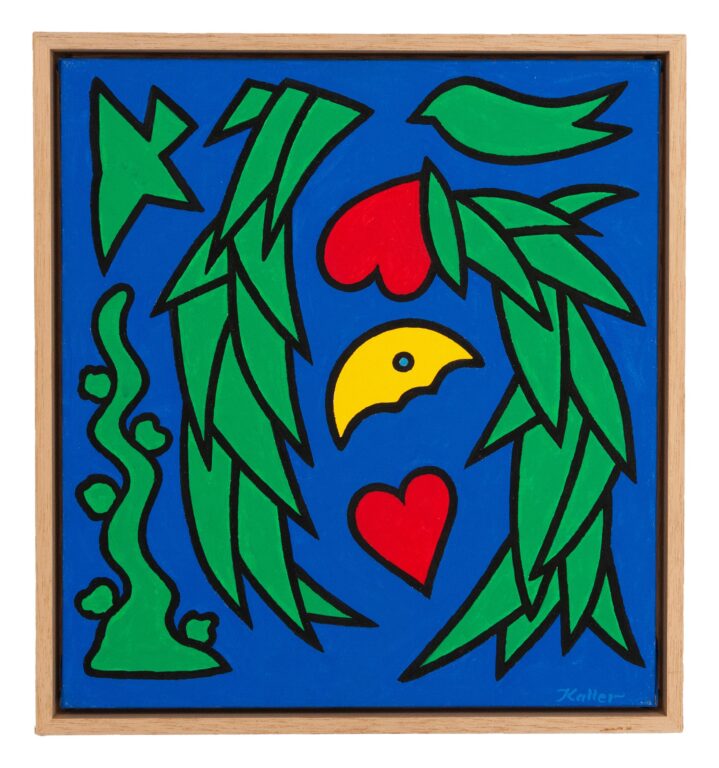
In Udo Kaller’s Yellow Hearts, we encounter familiar motifs that move between representation and abstraction. Divided into a grid of squares, the composition features houses, birds, and other forms that gradually become detached from their original appearance. What initially seems clearly recognizable develops into an interplay of color, line, and geometric order.
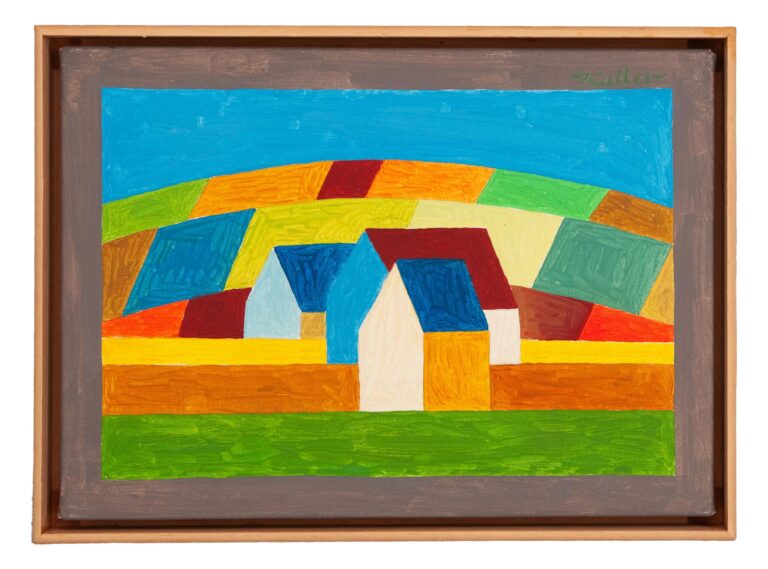
The predominant green unifies the individual sections into a cohesive composition. Within this structure, a red face and two yellow hearts create striking accents. The hearts, in particular, belong to those simple symbols whose meaning we recognize immediately, regardless of how greatly their form is simplified.
Kaller’s work invites us to reflect on the boundaries of our perception. How few visual elements are needed for us to recognize a motif? And at what point do we stop seeing a form as a representation and begin to perceive it as an independent composition? Yellow Hearts reveals how closely recognition and abstraction are connected, and how profoundly our experiences shape what we see in an image.