Parsifal – Männer ohne Frauen - Markus Lüpertz

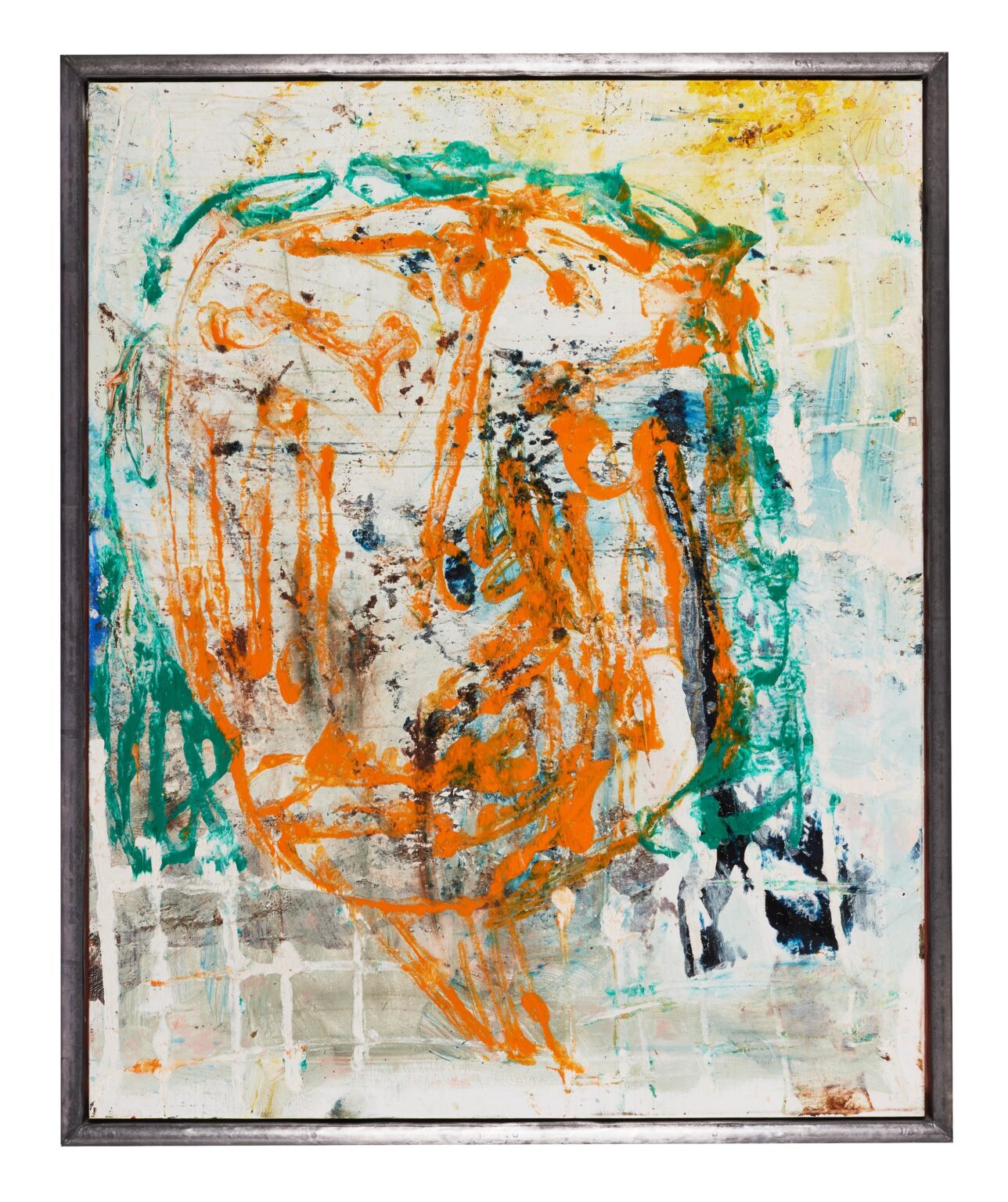
In Parsifal – Men Without Women, created in 1994, Markus Lüpertz takes up one of those themes in which his engagement with the figure, mythology, and the possibilities of painting come together with particular intensity. At the centre is the human head – not, however, as an individual portrait. Rather, the face becomes the starting point for a painterly investigation in which recognisability and dissolution, drawing and colour, figuration and abstraction are held in tension.

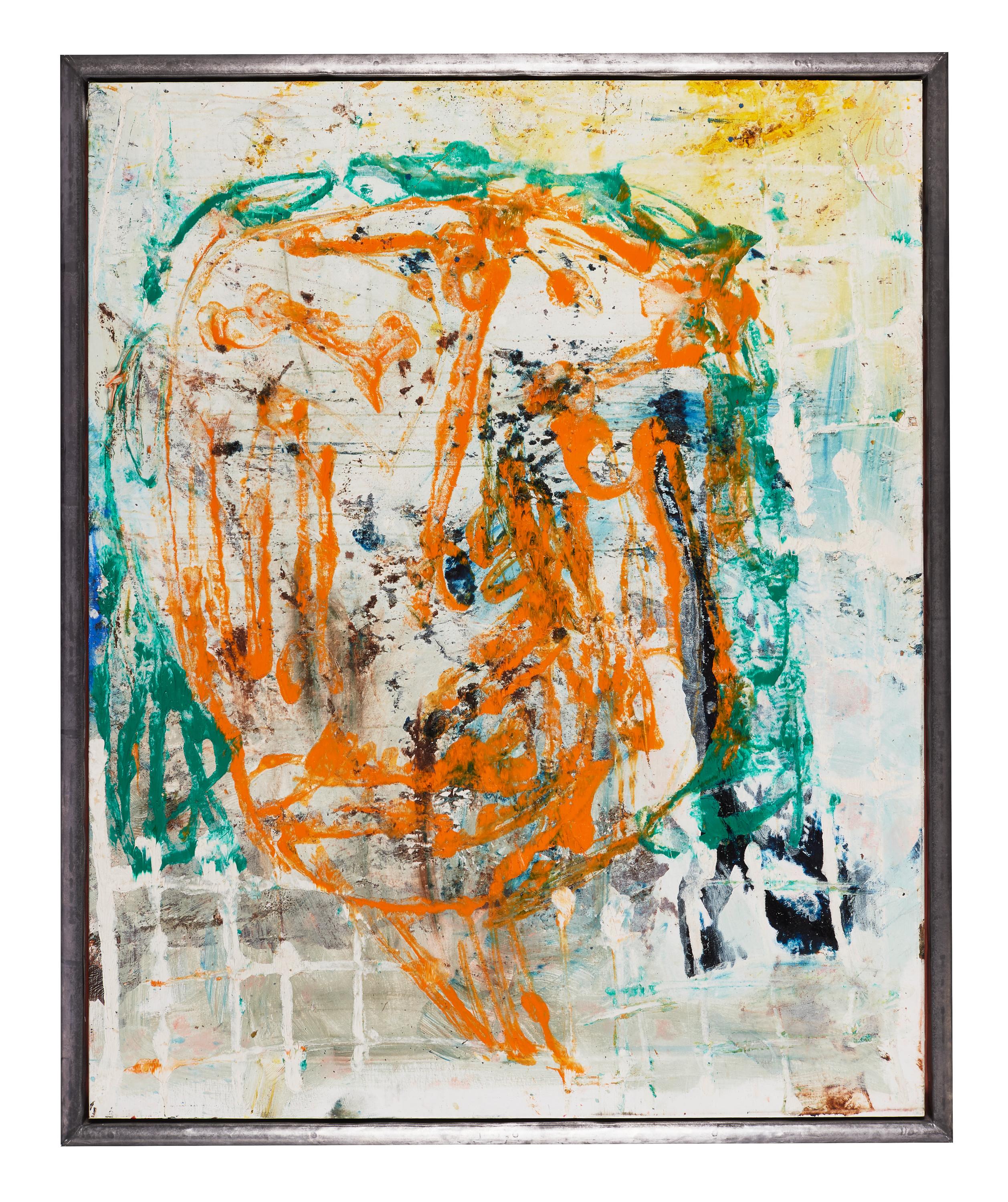
The monumental form of the head dominates almost the entire pictorial field. Powerful orange lines define the face, eyes, and contours without fixing them completely. Turquoise and green tones surround the figure, while dark accents and open areas repeatedly disrupt its sense of cohesion. Traces of the brush, overpainting, runs of colour, and exposed layers make the process of the painting’s creation visible. As a result, the face appears less as a clearly defined form than as something that takes shape in the very act of painting while simultaneously beginning to withdraw again.

This is precisely where one of the essential characteristics of Lüpertz’s art lies. His motifs rarely serve a narrative or illustrative purpose. Instead, they become points of departure for the question of what a painting can be. The human head becomes a form that can be repeated, altered, fragmented, and reassembled. In its major Lüpertz exhibition of 2019/20, the Haus der Kunst in Munich highlighted this practice of working in series and variations as a fundamental principle of his oeuvre. Since the early 1960s, Lüpertz has developed motifs across extended sequences of works, using repetition to continually open up new pictorial possibilities.

The title Parsifal also opens up a broader field of cultural and historical associations. Since the medieval tradition, and later through Richard Wagner’s stage work, the figure of Parsifal has stood for the search for knowledge, suffering, and redemption. Lüpertz does not, however, draw on this material in order to depict a particular episode. Instead, the myth becomes an open carrier of meaning. The face may be understood as a figure, but equally as a mask, a memory, or an archetypal sign. The designation “Men Without Women” reinforces this sense of isolation and existential concentration.

Position within the Oeuvre

The 1994 work belongs to the immediate period in which this group of works was developed. Institutional collections document the cycle over several years: The Museum of Modern Art, New York, holds an Untitled (Men Without Women – Parsifal) from 1993 as well as further works from 1997. Particularly important for the classification of the present painting is the Musée d’Art Moderne de Paris, whose collection includes several oil paintings entitled Men Without Women, Parsifal from 1994.

The present work therefore does not stand in isolation, but forms part of a clearly defined and institutionally documented body of work. At the same time, it demonstrates with particular clarity a fundamental principle of Lüpertz’s painting: the figure remains recognisable, yet is subordinated to the act of painting itself. Colour does not simply describe the face; it possesses its own material and spatial presence. Lines do not merely delimit forms, but develop an independent movement across the pictorial surface.

Parsifal – Men Without Women from 1994 can therefore be understood as a characteristic example of Lüpertz’s engagement with the human image. Myth and figure provide the point of departure, but the actual event takes place within the painting itself. The human head does not become a psychological representation of a particular individual, but rather a pictorial figure suspended between presence and dissolution, memory and the present, figuration and abstraction.

It is precisely this tension that makes the Parsifal group of works such a distinctive part of Lüpertz’s oeuvre.

Enquiry